
Stop focusing only on price. Here is the transparent workflow of how we turn your concept into a reliable product at CHK.
Article Summary
Many B2B buyers focus on price, samples, and lead time when sourcing induction cookers—but few truly understand how an OEM factory operates behind the scenes.
This article explains the complete induction cooker OEM operation process from a manufacturer’s perspective, including project evaluation, engineering feasibility, testing, certification, mass production, and long-term support.
By understanding these internal workflows, buyers can better control risk, improve scalability, and build more reliable long-term OEM partnerships.
1. Why Understanding OEM Operations Matters for Buyers
In B2B sourcing, many buyers focus on price, samples, and lead time.
However, a more fundamental question is often overlooked:
🔵 How does an induction cooker OEM factory actually operate behind the scenes?
Whether you understand this process directly affects whether your project is:
- Controllable (risk and timeline)
- Scalable (from pilot to mass production)
- Suitable for long-term cooperation
🔵 OEM operation capability determines project outcome more than quoted price.
2. What Defines a Professional Induction Cooker OEM Factory?
Many buyers assume OEM means simple private labeling.
In reality, OEM is not simply private labeling. OEM capability is defined by engineering depth and system control.
A professional induction cooker OEM factory typically provides:
| Dimension | Basic Supplier | Professional OEM Factory |
|---|---|---|
| 1. R&D Capability | External/limited | In-house engineering team |
| 2. Core Components | Spot sourcing | Stable, controlled supply |
| 3. Production System | Assembly-focused | Structured process control |
| 4. Certification | Buyer-driven | Compliance-driven support |
| 5. Cooperation Mode | Transactional | Long-term partnership |
🔵 True OEM cooperation is about technical and manufacturing synergy — not just cost.
3. Induction Cooker OEM Operation Process Explained Step by Step
OEM Process Logic from a Manufacturer’s Perspective
A professional induction cooker OEM process follows a clear logic:
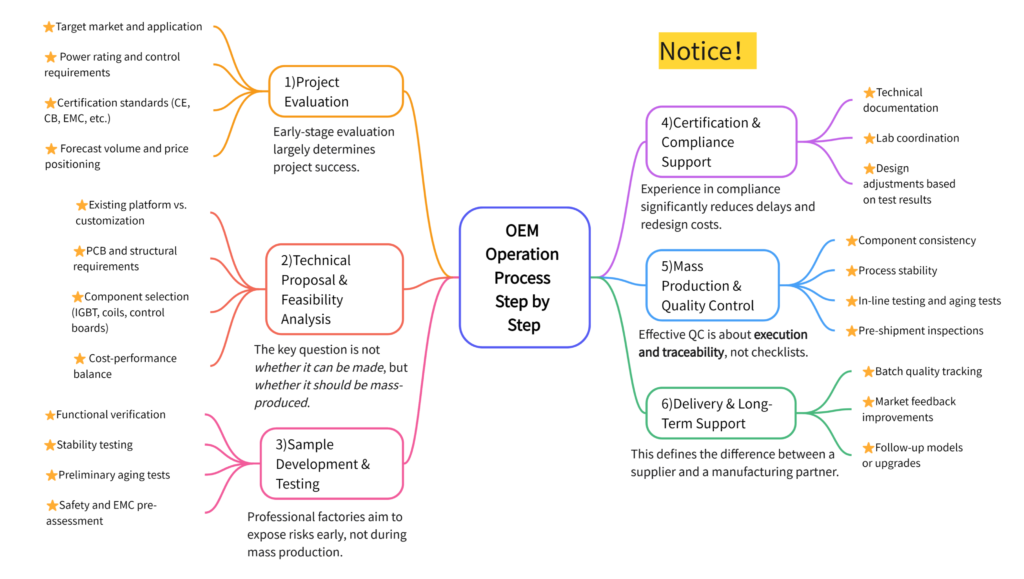
early evaluation → technical feasibility → risk exposure → compliance assurance → controlled mass production → long-term support.Each stage builds on the previous one. Skipping or simplifying early steps often leads to higher costs, delays, or quality issues during mass production.
| OEM Stage | Factory Focus | Why It Matters for B2B Buyers |
|---|---|---|
| 1)Project Evaluation | Market requirements, power specs, certifications, volume forecast | Determines whether the project is controllable and scalable from the start |
| 2)Technical Proposal & Feasibility | Platform selection, PCB & structure design, component matching | Avoids over-customization and hidden costs or reliability risks. |
| 3)Sample Development & Testing | Functional tests, stability checks, aging tests, EMC pre-evaluation | Identifies technical risks before mass production, not after. |
| 4)Certification & Compliance | Technical documents, lab coordination, and design adjustments | Reduces approval delays and repeated testing costs. |
| 5)Mass Production & Quality Control | Component consistency, process stability, in-line testing | Ensures batch-to-batch quality and long-term reliability. |
| 6)Delivery & Long-Term Support | Batch quality tracking, market feedback improvements, follow-up models, or upgrades | This defines the difference between a supplier and a manufacturing partner. |
| Avoids over-customization and hidden costs or reliability risks | Quality tracking, feedback improvement, and follow-up models | Defines whether the factory is a supplier or a true manufacturing partner. |
Or you can refer to the detailed mind map:
4. Common Risks When Buyers Do Not Understand OEM Operations
Lack of OEM process understanding often leads to:
- Choosing price-only suppliers
- Underestimating project risks
- Mismatch with long-term cooperation goals
🔵 For induction cookers, system reliability always outweighs short-term cost savings.
5. Why Work with an Experienced Induction Cooker OEM Manufacturer
Understanding how an induction cooker OEM factory operates helps buyers look beyond price, samples, and lead time.
As explained above, OEM capability is reflected in early project evaluation, engineering feasibility, testing, certification, and long-term production control — not in quotation alone.
However, even with a clear understanding of the OEM process, buyers still face a practical challenge in real sourcing scenarios:
Many factories claim to offer OEM or ODM services, but their actual operational capability varies significantly.
This leads to the next logical question for B2B buyers:
👉How can buyers distinguish a truly reliable induction cooker OEM / ODM factory from those that only appear good on paper?
In the next article, we will focus on practical evaluation criteria from a buyer’s perspective, helping you assess factories based on engineering depth, manufacturing stability, and long-term cooperation potential.